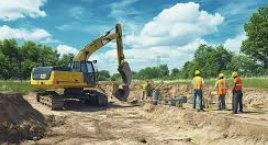
🏗️ Site Preparation in Construction
🔍 Purpose
Site Preparation is the first and most important step in any construction project. It ensures that the land is safe, stable, and ready for building. Proper site preparation improves structural stability, prevents settlement issues, and ensures smooth execution of construction work.
⚙️ Major Steps in Site Preparation
- Site Investigation & Surveying
- Clearing the Site
- Earthwork – Excavation
- Grading & Levelling
- Soil Testing
- Compaction
- Providing Utilities & Drainage
- Site Marking & Layout
🧪 1️⃣ Site Investigation & Surveying
This includes studying soil type, load-bearing capacity, groundwater level, and site boundaries using modern survey equipment.
- Total Station Survey
- Contour Mapping
- Soil Classification
- Topographical Survey
🧹 2️⃣ Clearing the Site
Removing vegetation, trees, bushes, debris, rocks, old structures, and unwanted materials.
- Cutting trees and bushes
- Removing stumps and roots
- Demolition (if required)
- Disposal of waste as per norms
⛏️ 3️⃣ Earthwork – Excavation
Excavation is done to prepare foundations, trenches, and basements as per structural drawings.
- Manual or mechanical excavation
- Trench excavation for footing
- Basement and pit excavation
- Shoring & shuttering if needed
📏 4️⃣ Grading & Levelling
Grading ensures the site has proper slopes for drainage and stability. Levelling makes the land flat for construction.
- Laser level checking
- Cutting high areas
- Filling low areas
- Ensuring uniform slope
🧪 5️⃣ Soil Testing
Soil testing determines whether the land can safely support the structure.
- SPT (Standard Penetration Test)
- CBR Test
- Plate Load Test
- Moisture Content Test
- Grain Size Analysis
🔨 6️⃣ Compaction
Compaction increases soil density and reduces settlement after construction.
- Using rollers and compactors
- Layer-wise compaction
- Achieve 95–98% Proctor Density
💧 7️⃣ Utilities & Drainage
Provision for water, temporary electricity, drainage channels, and site office.
- Temporary water supply
- Drainage arrangement
- Temporary fencing
- Site storage area
📐 8️⃣ Site Marking & Layout
Marking the foundation, column grids, and boundaries using lime powder, markers, and total station.
- Gridline marking
- Centerline marking
- Setting out foundation
🏗️ Equipment Used in Site Preparation
- Excavators
- Bulldozers
- Dumpers
- Rollers
- Water tankers
- Survey instruments
📊 Summary Table
| Step | Description | Purpose |
|---|---|---|
| Site Clearing | Remove trees, debris, rocks | Make the area ready for work |
| Excavation | Digging soil for foundations | Prepare footing base |
| Leveling | Cutting & Filling | Ensure even ground |
| Compaction | Compress the soil | Increase stability |
| Soil Testing | Check soil strength | Safe construction design |
📘 Conclusion
Proper site preparation is essential for long-term structural safety. It reduces risks, prevents future settlement, and ensures smooth construction progress. A well-prepared site provides a strong and stable foundation for the building and improves overall project quality.