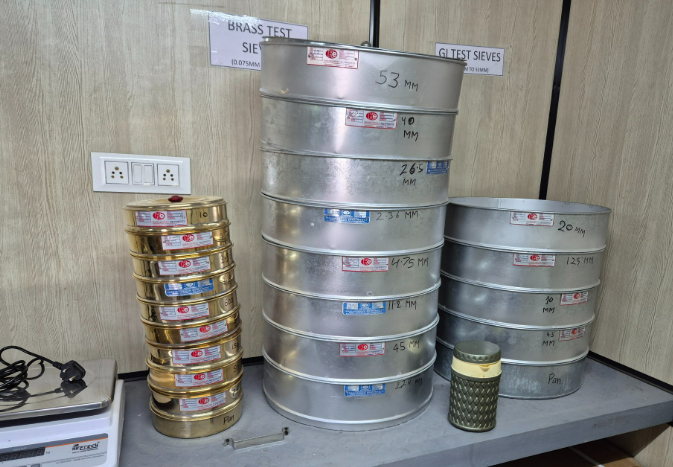
🏗️ Sieve Analysis Test for Coarse Aggregate
🎯 Aim
To determine the particle size distribution (gradation) of a given sample of coarse aggregate and classify it for use in concrete, as per IS 2386 (Part I).
⚙️ Apparatus Required
- Set of IS sieves (typically 80 mm, 40 mm, 20 mm, 10 mm, 4.75 mm and pan)
- Weighing balance (accuracy ±0.1 g)
- Mechanical sieve shaker (or manual shaking equipment)
- Oven (100–110 °C) for drying sample
- Brush for cleaning sieves, pan and cover
- Representative sample of coarse aggregate (about 5 kg depending on nominal maximum size)
🔬 Theory
Sieve analysis determines how the aggregate particles are distributed by size. Proper grading helps achieve optimum packing, reduce voids, improve workability and strength of concrete.
🧪 Sample Preparation
- Obtain a representative sample of coarse aggregate (commonly about 5 kg; for larger nominal sizes a larger sample may be required).
- Dry the sample in an oven at 100–110 °C until constant weight is achieved.
- Allow to cool and weigh the total sample mass (Wt).
🔧 Procedure
- Stack the sieves in descending order of size with the largest on top (for example: 80 mm, 40 mm, 20 mm, 10 mm, 4.75 mm, pan).
- Place the dried sample on the top sieve and cover with the pan cover.
- Place the sieve stack on the mechanical shaker and operate for 10–15 minutes, or shake manually until no further significant movement of particles is observed.
- After sieving, carefully remove each sieve, weigh the material retained on each sieve and record the weights.
- Clean and return the retained material to the pan to verify total mass equals Wt (allowing for minimal handling losses).
📐 Calculations
For each sieve:
Percentage retained = (Weight retained on sieve / Total sample weight Wt) × 100
Cumulative percentage retained = Sum of percentage retained on that sieve and all sieves above it
Percentage passing = 100 − Cumulative percentage retained
📋 Typical Observation Table (example)
| IS Sieve (mm) | Weight Retained (g) | % Retained | Cum. % Retained | % Passing |
|---|---|---|---|---|
| 80 | 0 | 0.0 | 0.0 | 100.0 |
| 40 | 200 | 4.0 | 4.0 | 96.0 |
| 20 | 1200 | 24.0 | 28.0 | 72.0 |
| 10 | 1800 | 36.0 | 64.0 | 36.0 |
| 4.75 | 1500 | 30.0 | 94.0 | 6.0 |
| Pan | 300 | 6.0 | 100.0 | 0.0 |
| Total | 5000 | 100.0 |
📈 Grading Curve
Plot sieve size (log scale) on the x-axis and cumulative % passing on the y-axis to obtain the grading curve. Compare the curve with IS 383 recommended grading limits for the nominal size.
📏 Classification & Use
- Nominal maximum size of aggregate and grading determine suitability for different concrete applications (e.g., 20 mm, 10 mm).
- Well-graded aggregate reduces voids and improves concrete workability and strength.
🧾 Fineness Modulus for Coarse Aggregate (optional)
Fineness modulus is more commonly used for fine aggregate, but coarse aggregates are reviewed against grading bands specified in IS 383 to ensure proper particle size distribution for the intended concrete mix.
⚠️ Precautions
- Use a representative and correctly sized sample for the nominal maximum size.
- Dry the sample to constant weight and handle sieves carefully to avoid losses.
- Do not overload any sieve; if overloaded, split the sample and test subdivisions.
- Repeat test or use mechanical shaker to obtain consistent results.
✅ Result & Conclusion
From the table above, calculate the cumulative % passing and check compliance with IS 383 grading limits for the selected nominal size. If the sample grading falls within the specified limits, the coarse aggregate is suitable for that class of concrete. Properly graded coarse aggregate contributes to good workability, reduced cement demand, improved density and higher strength of concrete.
📘 References
- IS 2386 (Part I) – Methods of Test for Aggregates for Concrete: Particle Size and Shape
- IS 383 – Specification for Coarse and Fine Aggregate from Natural Sources for Concrete