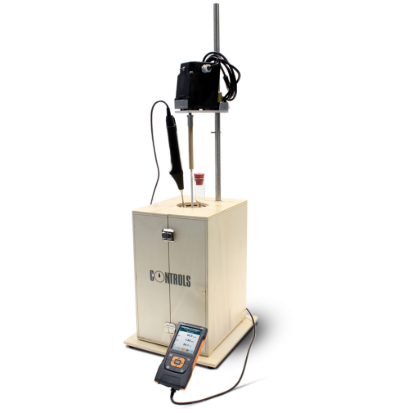
🔥 Heat of Hydration Test of Cement
📘 Aim
To determine the Heat of Hydration (HoH) of cement using a calorimeter as per IS 4031 (Part 9):1988.
🔍 Purpose
The heat of hydration is the amount of heat released when cement reacts with water during hydration. This reaction is exothermic and plays a crucial role in the strength development and temperature control of concrete, especially in mass concrete works such as dams and foundations.
⚙️ Apparatus Required
- Calorimeter (Vicat or Langavant type)
- Weighing balance (accuracy ±0.1 g)
- Thermometer (range up to 100°C)
- Dewar Flask or Insulated Container
- Water bath (to maintain temperature)
- Stopwatch
🧱 Material
- Cement sample (freshly prepared)
- Distilled water
🧪 Principle
When water is added to cement, chemical reactions occur between cement compounds (C₃S, C₂S, C₃A, C₄AF), producing heat. This released heat increases the temperature of the surroundings. By measuring this temperature rise using a calorimeter, we can calculate the total heat of hydration in calories or joules per gram of cement.
🧾 Chemical Reaction
The simplified reactions producing heat are:
- 2C₃S + 6H → C₃S₂H₃ + 3Ca(OH)₂ + Heat
- 2C₂S + 4H → C₃S₂H₃ + Ca(OH)₂ + Heat
🧪 Procedure
- Weigh about 60 g of cement accurately.
- Prepare a paste with water-cement ratio = 0.40.
- Immediately place the paste in the calorimeter.
- Seal the calorimeter tightly to avoid heat loss.
- Immerse the calorimeter in a constant temperature water bath.
- Record the temperature rise at fixed intervals (e.g., every 30 minutes) for up to 24 hours.
- Note the maximum temperature rise and calculate the heat of hydration using the formula.
🧮 Formula
Heat of Hydration (H) = (W × C × ΔT) / M
Where:
- H = Heat of hydration (cal/g or J/g)
- W = Weight of water + calorimeter parts (g)
- C = Specific heat of water (1 cal/g°C)
- ΔT = Rise in temperature (°C)
- M = Weight of cement (g)
Conversion:
1 cal/g = 4.186 J/g
📊 Observation Table
| Time (hours) | Temperature (°C) | Temperature Rise (°C) |
|---|---|---|
| 0 | 27.0 | - |
| 0.5 | 28.8 | 1.8 |
| 1.0 | 30.2 | 3.2 |
| 3.0 | 32.4 | 5.4 |
| 6.0 | 34.0 | 7.0 |
| 24.0 | 36.2 | 9.2 |
Example Calculation:
Given:
- W = 300 g
- ΔT = 9.2°C
- M = 60 g
H = (300 × 1 × 9.2) / 60 = 46 cal/g = 192.6 J/g
✅ Result
The heat of hydration of the given cement sample is 192.6 J/g.
📋 Typical Values
- Ordinary Portland Cement (OPC): 75 – 100 cal/g (315 – 420 J/g)
- Low Heat Cement: 50 – 60 cal/g (210 – 250 J/g)
📖 Significance
- High heat of hydration may cause thermal cracking in mass concrete.
- Low heat cement is preferred for large structures such as dams and retaining walls.
- Used to control the temperature rise in concrete curing.
⚠️ Precautions
- Ensure the calorimeter is properly sealed to prevent heat loss.
- Conduct the test in a controlled environment (27 ± 2°C).
- Use freshly mixed cement paste for accurate results.
- Record temperature readings precisely at fixed intervals.
📘 Conclusion
The Heat of Hydration Test determines the heat released during the hydration of cement. The measured value of 192.6 J/g indicates normal hydration characteristics suitable for use in reinforced and mass concrete structures. Controlling heat of hydration helps in preventing thermal stresses and cracks in concrete.