🏗️ Specific Gravity Test of Cement
📘 Aim
To determine the specific gravity of cement using a Le Chatelier Flask as per IS 4031 (Part 11):1988.
🔍 Purpose
The specific gravity of cement indicates the density of cement particles relative to water. It helps identify whether the cement contains excess moisture or impurities such as lime or ash. Fresh Ordinary Portland Cement (OPC) typically has a specific gravity of about 3.15.
⚙️ Apparatus Required
- Le Chatelier Flask (capacity 250 ml)
- Weighing balance (accuracy ±0.1 g)
- Kerosene or naphtha (free from water)
- Glass funnel
- Clean dry cloth
🧱 Material
- Cement sample (fresh and free from lumps)
- Kerosene – used as a non-reactive liquid
🧪 Procedure
- Clean and dry the Le Chatelier Flask thoroughly.
- Fill the flask with kerosene up to a certain mark (say, initial reading = V₁).
- Weigh about 64 g of cement accurately.
- Carefully introduce the cement into the flask using a funnel. Ensure no air bubbles are trapped.
- After adding all cement, roll the flask gently in an inclined position to remove trapped air.
- Note the new level of kerosene (final reading = V₂).
- Record all observations and proceed to calculate the specific gravity.
🧮 Formula
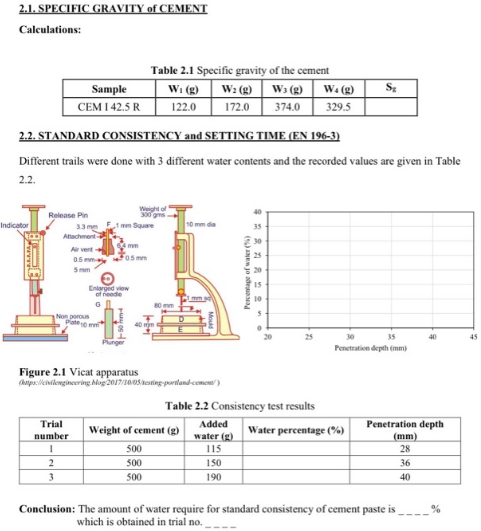
Specific Gravity (G) = (W₂ - W₁) / [(W₄ - W₁) - (W₃ - W₂)]
Where:
- W₁ = Weight of empty flask
- W₂ = Weight of flask + kerosene
- W₃ = Weight of flask + kerosene + cement
- W₄ = Weight of flask + cement only
Alternate Simplified Formula (using volumes):
Specific Gravity (G) = Wc / (V₂ - V₁) × ρ
Where:
- Wc = Weight of cement (g)
- V₂ - V₁ = Volume of kerosene displaced by cement (ml)
- ρ = Density of kerosene (0.79 g/ml)
📊 Observation Table
| Parameter | Symbol | Observation |
|---|---|---|
| Weight of cement | Wc | 64 g |
| Initial reading of kerosene | V₁ | 0 ml |
| Final reading after adding cement | V₂ | 20.3 ml |
| Density of kerosene | ρ | 0.79 g/ml |
Calculation:
G = 64 / (20.3 × 0.79) = 3.14
✅ Result
The specific gravity of cement = 3.14.
📋 Typical Values
- Ordinary Portland Cement (OPC): 3.10 – 3.16
- Portland Pozzolana Cement (PPC): 2.90 – 3.10
- Rapid Hardening Cement: 3.15 – 3.19
📖 Significance
- Indicates the purity and quality of cement.
- Used in mix design calculations to determine the proportions of materials.
- Helps in identifying the presence of adulteration or moisture.
⚠️ Precautions
- Ensure kerosene is free from moisture and air bubbles.
- The flask should be dry and clean before use.
- Conduct the test at room temperature (27 ± 2°C).
- Avoid shaking the flask vigorously to prevent air entrapment.
📘 Conclusion
The Specific Gravity Test of Cement was performed using the Le Chatelier Flask method as per IS 4031 (Part 11):1988. The specific gravity was found to be 3.14, which is within the standard range for Ordinary Portland Cement, confirming that the cement sample is of good quality and suitable for use in concrete works.