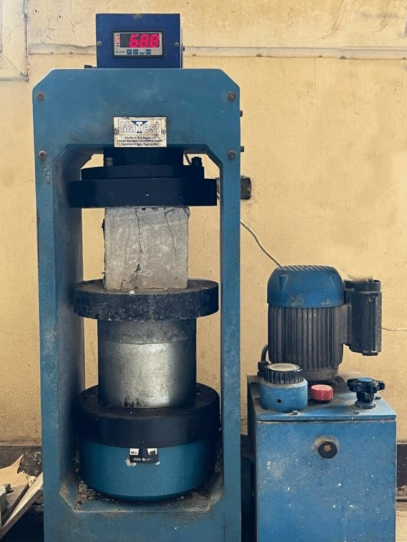
💪 Compressive Strength Test of Cement
📘 Aim
To determine the compressive strength of cement as per IS: 4031 (Part 6) – 1988 using standard mortar cubes.
⚙️ Apparatus Required
- Compression testing machine (CTM)
- Cement cube moulds (70.6 mm × 70.6 mm × 70.6 mm)
- Vibrating machine or hand compaction rod
- Trowel
- Glass plate
- Balance (accuracy ±1 g)
- Measuring cylinder
- Water and sand (standard Ennore or ISO sand)
📏 Theory
The compressive strength of cement is a measure of its ability to withstand loads without failure. It represents the load at which a cement mortar cube fails under compression. The test is conducted on 1:3 cement-sand mortar cubes after curing for specific periods (3, 7, and 28 days).
🧪 Test Standard
As per IS: 4031 (Part 6) – 1988, the compressive strength of cement is tested using 70.6 mm cubes made with a 1:3 ratio of cement and standard sand, with a water-cement ratio of 0.40.
🧰 Mix Proportion
- Cement : Sand = 1 : 3 (by weight)
- Water-Cement Ratio (W/C) = 0.40
🧱 Procedure
- Weigh 200 g of cement and 600 g of standard sand (ratio 1:3).
- Mix dry for about 1 minute, then add water equal to 0.40 × weight of cement.
- Mix thoroughly for 3–4 minutes until uniform consistency is achieved.
- Fill the cube moulds in 3 layers, compacting each layer using a vibrating machine or tamping rod (20 strokes/layer).
- Level the surface and cover with a glass plate to prevent evaporation.
- After 24 ± 0.5 hours, remove cubes from moulds and place them in a water-curing tank at 27°C ± 2°C.
- Test the cubes in a compression testing machine at ages of 3 days, 7 days, and 28 days.
- Record the maximum load at failure for each cube.
🧮 Formula for Compressive Strength
Compressive Strength (N/mm²) = P / A
Where,
P = Maximum load at failure (N)
A = Cross-sectional area of cube (mm²)
For 70.6 mm cube, A = (70.6 × 70.6) = 4984 mm²
📊 Observation Table
| Age of Cube | Load at Failure (N) | Compressive Strength (N/mm²) |
|---|---|---|
| 3 days | 120,000 | 24.1 |
| 7 days | 180,000 | 36.1 |
| 28 days | 240,000 | 48.1 |
✅ Result
- Average Compressive Strength after 3 days = 24.1 N/mm²
- Average Compressive Strength after 7 days = 36.1 N/mm²
- Average Compressive Strength after 28 days = 48.1 N/mm²
📋 Permissible Limits (as per IS 12269:2013)
| Type of Cement | 3 Days (MPa) | 7 Days (MPa) | 28 Days (MPa) |
|---|---|---|---|
| OPC 33 Grade | 16 | 22 | 33 |
| OPC 43 Grade | 23 | 33 | 43 |
| OPC 53 Grade | 27 | 37 | 53 |
🧩 Significance
- Determines the load-bearing capacity of cement mortar.
- Helps in classifying cement grades (33, 43, and 53).
- Indicates the strength development rate of cement.
⚠️ Precautions
- Use standard sand and maintain the correct water-cement ratio.
- Clean moulds and equipment before use.
- Cure the cubes properly at 27°C ± 2°C.
- Ensure uniform compaction and no air voids.
📘 Conclusion
The average compressive strength of cement mortar cube after 28 days is 48.1 N/mm², which satisfies the IS 4031 (Part 6):1988 requirement for OPC 43 Grade cement. Hence, the cement is suitable for construction use.