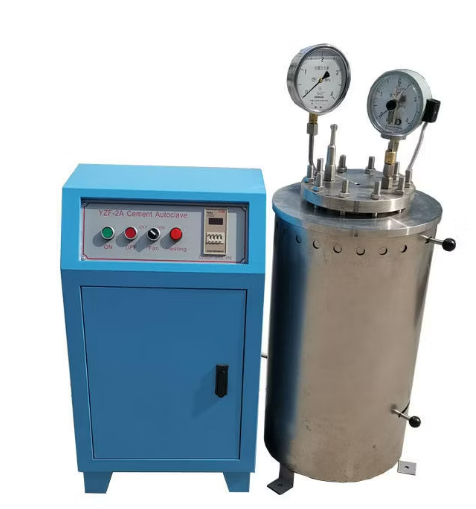
🔥 Autoclave Test for Soundness of Cement
📘 Aim
To determine the soundness of cement by the autoclave method as per IS: 4031 (Part 3) – 1988.
🔍 Purpose
The soundness of cement indicates its ability to retain its volume after setting. Unsound cement expands excessively due to the presence of free lime (CaO) or magnesia (MgO), leading to cracks or disintegration in concrete.
The Autoclave Test is used when high accuracy is required, especially for detecting unsoundness due to free MgO.
⚙️ Apparatus Required
- Autoclave (pressure resistance up to 21 kg/cm²)
- Length comparator
- Cement paste moulds (25 × 25 × 250 mm prisms)
- Trowel and glass plate
- Balance (accuracy ±1 g)
- Water bath
🧱 Test Specimen
- Prepare a neat cement paste of standard consistency.
- Fill the moulds (25 × 25 × 250 mm) and compact properly.
- Store the moulds in a moist cabinet for 24 hours.
🧪 Procedure
- After 24 hours, remove the specimen from the mould.
- Measure its initial length using the length comparator (L₁).
- Place the specimen inside the autoclave containing water.
- Gradually raise the pressure in the autoclave to 21 kg/cm² (2.1 MPa) within 1 hour.
- Maintain this pressure for 3 hours.
- After completion, release the pressure slowly and cool the specimen to room temperature.
- Remove the specimen and measure the final length (L₂).
🧮 Calculation
Expansion (%) = ((L₂ – L₁) / L₁) × 100
Example:
If initial length L₁ = 250.00 mm and final length L₂ = 250.60 mm:
Expansion = ((250.60 – 250.00)/250.00) × 100 = 0.24 %
📊 Observation Table
| Sample | Initial Length (mm) | Final Length (mm) | Expansion (%) |
|---|---|---|---|
| Cement Prism 1 | 250.00 | 250.60 | 0.24 |
| Cement Prism 2 | 250.10 | 250.70 | 0.24 |
📋 Permissible Limits (as per IS: 269 & IS: 4031 Part 3)
- For Ordinary Portland Cement (OPC): Expansion ≤ 0.8 %
- For Rapid Hardening Cement: Expansion ≤ 0.8 %
- For Low Heat Cement: Expansion ≤ 0.8 %
🧩 Significance
- Ensures cement will not undergo excessive expansion after setting.
- Prevents cracking or disintegration in hardened concrete.
- Detects unsoundness due to both free lime and magnesia.
⚖️ Comparison: Le Chatelier vs Autoclave Test
| Aspect | Le Chatelier Test | Autoclave Test |
|---|---|---|
| Purpose | Detects expansion due to free lime (CaO) | Detects expansion due to lime and magnesia (CaO & MgO) |
| Pressure | At atmospheric pressure | Under 21 kg/cm² steam pressure |
| Specimen | Cement paste in split moulds | Cement prism 25×25×250 mm |
| Accuracy | Moderate | High |
| Standard | IS 4031 (Part 3) | IS 4031 (Part 3) |
⚠️ Precautions
- Ensure uniform mixing and compaction of cement paste.
- Release autoclave pressure slowly to prevent specimen damage.
- Maintain constant temperature and pressure during the test.
- Use clean water and apparatus.
✅ Result
The average expansion of the cement specimen = 0.24 %.
Since expansion ≤ 0.8 %, the cement is sound and suitable for construction use.
📘 Conclusion
The Autoclave Test is an accurate method to determine the soundness of cement. The tested sample showed an expansion of 0.24 %, which is within the permissible limit as per IS 4031 (Part 3):1988, confirming that the cement is free from unsoundness.