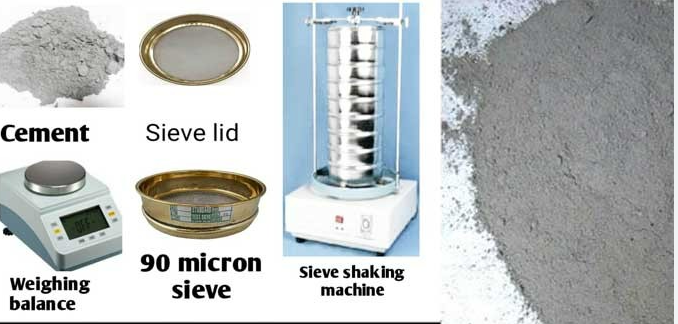
🏗️ Fineness Test for Cement
🔍 Purpose
The fineness of cement represents the particle size of cement and determines the total surface area available for hydration. It directly affects the rate of strength gain, workability, and durability of concrete. Finer cement reacts faster with water, producing higher early strength, while coarser particles reduce efficiency.
⚙️ Methods of Fineness Test
- Sieve Test (Dry Sieving Method) – Simple and quick for field checks.
- Air Permeability Test (Blaine’s Method) – More accurate, used in laboratories.
🧪 1️⃣ Sieve Test (IS: 4031 – Part 1: 1996)
Apparatus Required
- 90-micron IS sieve (No. 9)
- Weighing balance (accuracy 1 mg)
- Brush for cleaning
- 100 g cement sample
Procedure
- Weigh accurately 100 g of cement sample (W₁).
- Sieve the sample through IS 90-micron sieve for 15 minutes.
- Rotate and gently brush the sieve intermittently to avoid clogging.
- Collect and weigh the residue retained on the sieve (W₂).
Formula
Fineness (% retained) = (W₂ / W₁) × 100
Fineness (% passing) = 100 − (W₂ / W₁ × 100)
Example
If 4.5 g residue remains on the sieve after sieving 100 g cement:
Fineness (% retained) = (4.5 / 100) × 100 = 4.5%
✅ Result: 4.5% residue — within the permissible limit.
Permissible Limit (IS 4031)
- Residue on 90-micron sieve ≤ 10% by weight.
🧪 2️⃣ Air Permeability (Blaine’s Method)
This method determines the specific surface area of cement particles by measuring the air flow through a compacted cement bed. It is based on the principle that finer particles offer more resistance to air flow.
Formula
S = K √(t / ρ)
- S = Specific surface area (cm²/gm)
- K = Constant (depends on apparatus calibration)
- t = Time for air to pass through the sample (s)
- ρ = Density of cement (g/cm³)
Typical values for Ordinary Portland Cement (OPC): 225 – 325 m²/kg
📋 Factors Affecting Fineness
- Grinding time and efficiency of the mill.
- Type of clinker and gypsum added.
- Condition of sieves and cleanliness during testing.
- Moisture content in the sample.
✅ Advantages of Finer Cement
- Rapid development of early strength.
- Better cohesiveness and uniform mixing.
- Reduced bleeding and segregation in concrete.
⚠️ Disadvantages
- Increased water demand and shrinkage.
- Higher cost due to additional grinding.
- Possibility of cracks due to excessive fineness.
🧭 Precautions
- Ensure sieve is clean and not damaged.
- Do not overload the sieve with cement.
- Use brush gently to avoid forcing particles through.
- Conduct the test in a dry environment.
📊 Summary Table
| Property | Requirement | Result | Status |
|---|---|---|---|
| Cement sample | OPC 53 Grade | 100 g | - |
| Sieve used | 90 Micron (IS No.9) | - | - |
| Residue | ≤ 10% | 4.5% | ✅ OK |
| Specific Surface (Blaine) | 225–325 m²/kg | 280 m²/kg | ✅ OK |
📘 Conclusion
The fineness of cement significantly influences strength, setting time, and durability. For Ordinary Portland Cement (OPC), the residue on a 90-micron sieve should not exceed 10%, and the specific surface area should range between 225–325 m²/kg. The tested cement meets the requirements and is fit for use in high-quality concrete construction.